Thermomix Buying Guide · November 1, 2026 · 13 min read
Healthy Meals on a Budget with Your Thermomix
About 2.6 billion people couldn't afford a healthy diet in 2024, according to the European Commission's summary of the FAO food security report. A budget-friendly meal plan works best when it matches your household's money, time, storage, and energy.

On this page
About 2.60 billion people couldn't afford a healthy diet in 2024, according to the European Commission's summary of the FAO food security report. A budget-friendly meal plan works best when it matches your household's money, time, storage, and energy.
I'm Prinal Glassman, an Independent Thermomix® Consultant in Las Vegas, helping families across the USA. If you can follow a step on a screen, you can make dinner. Build a two-week plan around interchangeable low-cost proteins, grains, and produce, then track what your household eats. Keep the ingredients that get used, and adjust the next plan around what gets left behind.
What Healthy Meals on a Budget Should Cost
A useful starting point is the USDA Economic Research Service benchmark: the typical U.S. household spent $75 per person per week on food in 2024, about $300 for four people or $3,900 per person annually. That figure covers all household food, not dinner alone. Treat it as a comparison point, not a spending target.
For a hypothetical household budget, test a home dinner target of $2.50 to $4.50 per serving, or $10 to $18 for four. Those are planning figures, not guaranteed prices. Your receipts will show whether the target fits local grocery costs and your household's habits.
Dinner cost versus a weekly food budget
The takeout and meal-kit amounts below are examples, not standard prices. Replace them with your own totals, including delivery, shipping, fees, and tips.
Habit | What you control |
|---|---|
Typical US food spending, 2024 | The USDA benchmark above covers all food, not dinner alone. Set a dinner allowance within your household total. |
Delivered takeout night | In an example costing $60 for the family, you control the menu, fees, and tip. |
Meal kit night | At an illustrative $8 to $12 per serving, check box size, shipping, and the total after introductory discounts. |
Planned grocery dinner | Test the $10 to $18 family target by controlling staples, portions, and waste. |
Three takeout nights cooked at home | In this example, $180 of avoided orders minus $40 to $55 of groceries leaves $125 to $140 before waste. Only count nights you replace. |
Delivery and groceries can both be the right choice. Compare what gets cooked and eaten: a grocery shop filled with ambitious ingredients can cost plenty if the meals go unmade. A meal kit that gets cooked may serve the household better than produce bought for a dinner that never happens.
Budget rule: Compare complete meals eaten, not a restaurant total against the price of a bag of rice.
Give a short paycheck week a smaller cap
The same USDA report says 86.3% of U.S. households were food secure throughout 2024, while 13.7% weren't food secure for the entire year. A dinner budget needs room for disruption, not only an average that looks tidy on paper.
When money tightens, lower the dinner cap before choosing recipes. Keep familiar meals and adjust the costly part: use beans in place of some meat, choose seasonal vegetables instead of specialty ingredients, or serve a simpler dinner with fewer extras. The right trade-off is the one your household will eat.
Before you plan, write down three figures:
Last month's takeout total: Include fees and tips.
Your last meal-kit box total: Include shipping and anything bought to complete the meals.
This week's grocery cap: Use the money available now, not the amount you wish were available.
Dinner can taste good and fit the household without carrying a nutritional halo. Measure your budget against meals your household will cook and finish.
Plan Two Weeks Before You Shop
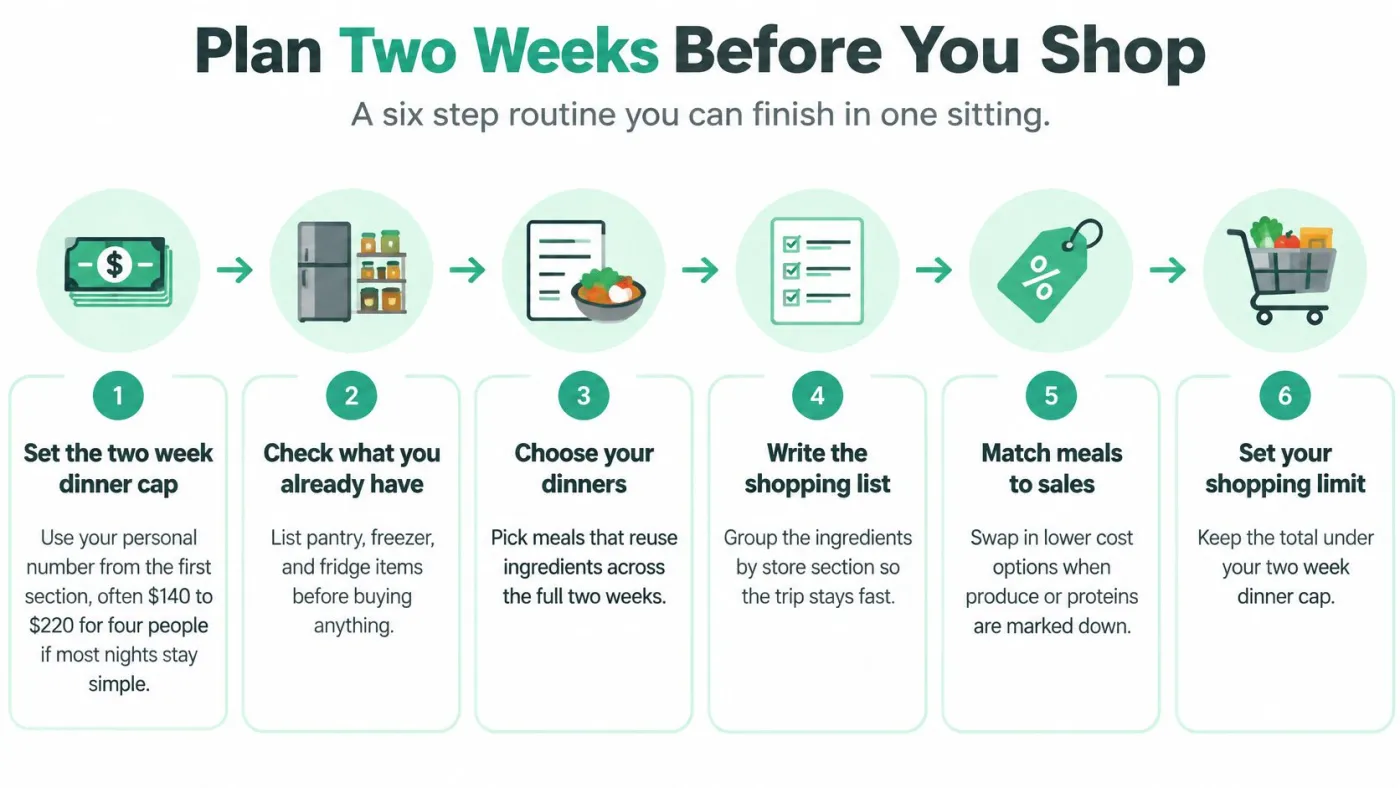
Using the hypothetical $2.50 to $4.50 per-serving target, dinner for four would cost $10 to $18. Write your personal spending numbers first, then choose a two-week dinner cap. An illustrative $140 to $220 could work when enough dinners stay toward the lower end, but it isn't a guarantee.
A Journal of Nutrition Education and Behavior menu study achieved healthy eating by balancing targets across two weeks, with family-of-four menus averaging approximately $25 daily at bulk and discount markets versus $39 at a specialty market, in 2010 dollars. Those aren't today's shopping targets. The useful finding is that you can plan nutrition and cost across a cycle rather than making every day identical.
Six decisions before the shopping list
Set the dinner cap. Reserve money for breakfasts, lunches, and household essentials separately. Don't accidentally spend the whole food budget on evening meals.
Count people and check supplies. Mark nights away, late workdays, and dietary needs. List what's already in the refrigerator, freezer, and cupboard before choosing another ingredient.
Choose repeating bases. Pick a bean or lentil base, a grain, seasoned poultry, and a vegetable mixture. Select suitable guided preparations rather than inventing a larger batch.
Assign each base a destination. Give the beans a chili night and a bowl night. Give poultry a dinner and a wrap filling. A leftover without an assigned eater is just a container with aspirations.
Make price-sensitive swaps. Reserve pricier fish for a smaller planned portion. If poultry jumps in price, replace that slot with beans or eggs, then select the appropriate guided recipe.
Write the list and check the total. Group ingredients by store section, remove anything already available, and trim optional extras until the list fits.
The study's prices excluded transportation, promotion research, and planning time. I would favor a manageable main shopping trip over chasing tiny savings through several stores.
Two week dinner grid example
These are meal destinations, not instructions to keep cooked food refrigerated until its next appearance. Freeze portions when their destination falls outside the safe refrigerator window.
Night | Base | Add in | Leftovers go to |
|---|---|---|---|
Week 1, Mon | Bean or lentil batch | Rice and frozen greens | Thu bowls |
Week 1, Tue | Seasoned chicken batch | Potatoes and carrots | Fri wraps |
Week 1, Thu | Bean or lentil batch | Tortillas and salsa | Lunch |
Week 1, Sat | Salmon in a small portion | Rice and salad | None |
Week 2, Mon | Egg and vegetable scramble | Oats and fruit | Breakfast |
Fill the remaining nights around your actual calendar. Leave a flexible slot for a safely stored meal rather than scheduling another purchase automatically.
Copy this blank grid before writing the shopping list:
Night | Base | Add in | Who eats leftovers |
|---|---|---|---|
______ | ______ | ______ | ______ |
______ | ______ | ______ | ______ |
______ | ______ | ______ | ______ |
______ | ______ | ______ | ______ |
Fill the Cart With Low Cost Staples
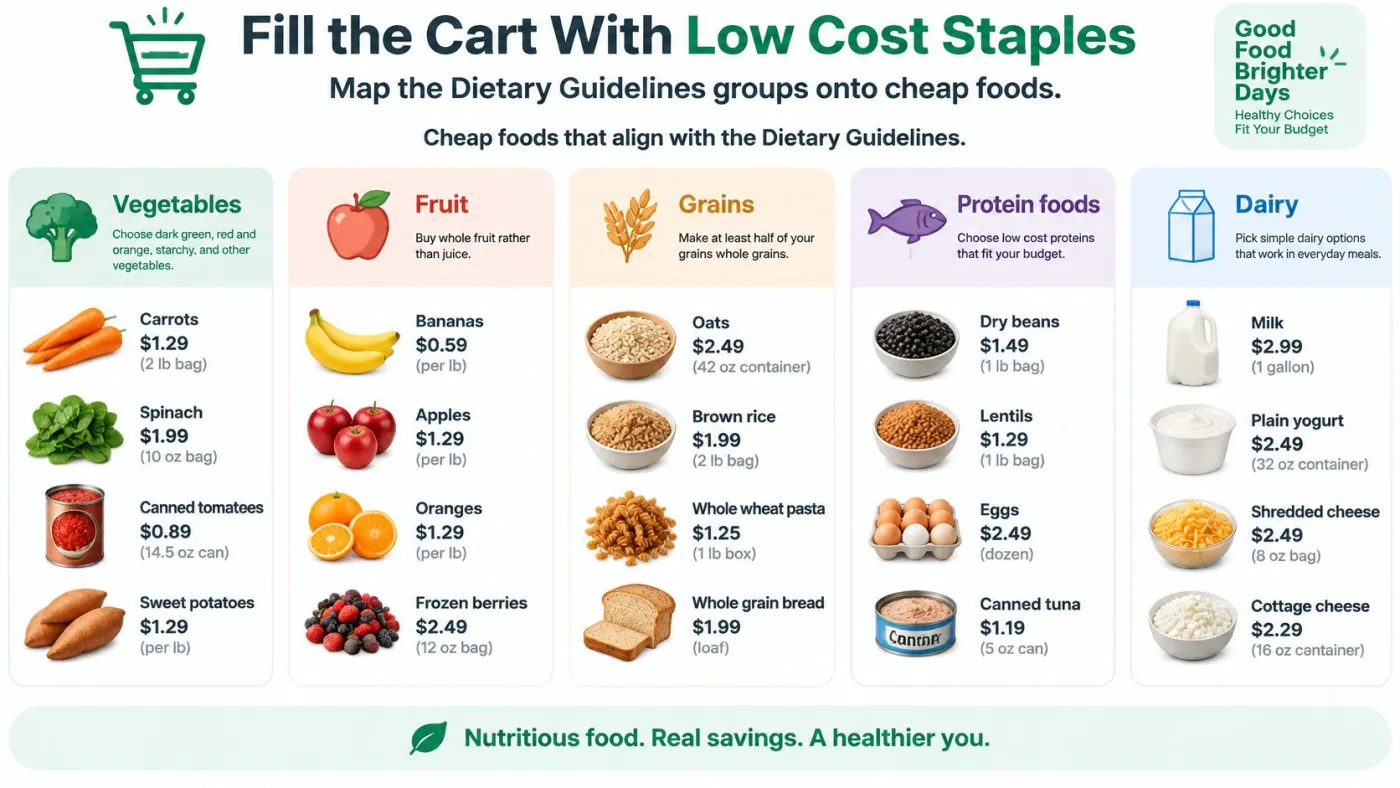
Shop by the job a food does, then compare its form. You need an affordable protein, a staple carbohydrate, produce, and an appropriate amount of fat. You don't need the exact brand or fashionable ingredient pictured beside a recipe.
The Dietary Guidelines for Americans recommend variety across vegetables, fruit, grains, dairy, and protein foods, including dark green, red and orange, starchy, and other vegetables; whole fruit rather than juice; and at least half of grains as whole grains. The guidelines also call for limits on added sugars, saturated fat, and sodium. Cheap shouldn't mean a cart consisting mainly of sugary boxes.
Staple forms and when each one wins
“Cheaper” below means the form to price-check first, not a universal price ranking. Local shelf prices and how much you finish decide the winner.
Food job | Cheaper form | Faster form | Pick it when |
|---|---|---|---|
Protein | Dried beans or lentils | Canned beans or eggs | You'll cook the dried batch this week |
Vegetable | Seasonal fresh or a large frozen bag | Canned tomatoes or frozen mixes | Fresh will be eaten within a few days; otherwise consider frozen |
Grain or starchy base | Bulk oats, rice, or potatoes | Quick oats or ready-cooked rice | The cupboard already has a home for the bag |
Fruit | In-season whole fruit | Frozen fruit | Juice isn't standing in for fruit |
Healthy fat | Peanut butter or a small bottle of oil | Nuts by the handful | The amount matches the two-week grid |
Dried beans can be economical, but they require planning and the correct preparation. Canned beans may cost more while saving a dinner you would otherwise order. Frozen vegetables can be the better purchase when fresh produce would spoil before its assigned meal.
Check sodium and added ingredients on packaged foods. Keep dairy or a suitable fortified alternative that your household already uses, rather than buying a new carton for a recipe that needs a splash.
A sample list to scale against your grid
For an illustrative household of four planning ten dinners, a starting list might include:
Protein bases: 2 lb (907 g) dried beans or lentils, 18 eggs, 3 lb (1,361 g) chicken thighs, and two cans of fish in the size your recipes specify.
Grains and starches: 5 lb (2,268 g) rice or oats, plus 4 lb (1,814 g) potatoes.
Produce: Six bags of frozen vegetables, sized to the selected recipes, and four pieces of seasonal fruit per person.
Usual refrigerated foods: Yogurt, milk, or an appropriate fortified alternative already included in your normal shop.
That's a planning example, not a nutritionally complete prescription. Subtract pantry supplies and adjust quantities to recipe yields and appetites.
Use our healthy eating resources when matching meals to household preferences. Compare unit prices, buy only the repeated bases your grid uses, and skip another store unless the saving clearly earns the extra trip.
Twelve Low Cost Thermomix Dinner Ideas
A budget dinner earns its place when your household eats it. I'd build these twelve ideas around a two-week rotation of interchangeable proteins, grains, and produce, then adjust the next shop according to what was finished and what was left. The Thermomix® TM7™ can chop, blend, cook, steam, and knead; its guided recipes provide the screen steps for quantities, loading order, times, temperatures, and speeds. Follow the chosen recipe rather than improvising settings.

Beans and vegetables that repeat well
Red lentil tomato stew
Pair lentils with tomatoes and greens for a filling bowl. Frozen greens fit naturally, and the same basic combination can return in the second week with a different vegetable or grain. Choose a guided recipe for its exact method.Black bean chili
Use canned beans for a quicker dinner, or correctly prepared beans when they are already part of the plan. Keep the tomato and seasoning base, then serve it with rice or another grain already in the rotation.Chickpea coconut curry
Chickpeas and vegetables make a flexible base. Check the guided recipe for the right balance of coconut milk and other liquid, then use whichever vegetables need a place in the week's meals.Minestrone
This is a useful destination for vegetables that need using, along with beans and tomatoes. Add pasta when the recipe directs; putting it in too early can leave it softer than intended.
Poultry, fish, and eggs
Chicken and rice with vegetables
This combines a protein, grain, and produce in one dinner. Follow a complete guided recipe for the chicken preparation, steaming arrangement, liquid, and doneness checks. An improvised setting is not a substitute for those steps.Turkey meatballs
Use seasoned turkey in a guided recipe that matches the meatball size and cooking arrangement. Make enough for the planned meal, then use any cooked leftovers as a later dinner component if the household will eat them.Canned salmon and potato bowls
Potatoes and vegetables provide the base, while ready-to-eat canned salmon adds a different protein option. Follow the recipe's directions for cooking the vegetables and adding the salmon, rather than treating the ingredients as interchangeable at every step.Egg and vegetable scramble
Eggs and prepared vegetables can turn a small collection of ingredients into dinner. The quantity matters, so follow a recipe written for the amount you are making instead of guessing from a previous meal.
Breakfast dinners and leftover destinations
Oat breakfast bowls
Oats and fruit work for dinner as readily as breakfast. Use the liquid and oat type specified in the guided recipe. No apology required.Banana oat muffins
Ripe bananas and oats make a practical way to use ingredients already in the rotation. Follow a guided batter recipe and its oven instructions rather than guessing at mixing or baking times.Bean and rice burrito bowls
Put safely stored chili and rice to work as a new meal, with vegetables or other planned toppings. Follow the guided reheating method and check the food itself; a timer alone does not confirm safe reheating.Pasta with white bean sauce
Blend cooked white beans and vegetables into a sauce using a matching guided recipe. Pasta needs its own instructions for shape and quantity, so follow the recipe's separate pasta step.
Browse the guided Thermomix recipe collection for exact screen steps. For each idea, compare the planned portions with what your household usually eats, then price the actual recipe. Swap ingredients by role, such as one protein for another, but choose a recipe that matches the replacement. A cheap ingredient is no saving if it sits uneaten.
Cool, Freeze, and Use Every Batch
Perishable food needs refrigeration within 2 hours, or within 1 hour when the surrounding temperature exceeds 90°F, according to USDA leftover safety guidance. The same guidance recommends keeping the refrigerator at 40°F or below, using properly stored cooked leftovers within 3 to 4 days, and reheating them to 165°F.
In a hot Las Vegas kitchen, check where the food is sitting. Get dinner packed away promptly, rather than leaving it out while everyone negotiates whose turn it is to clear the table.
Give the batch a destination immediately
Divide cooked food into shallow, covered containers to help it cool more quickly. Set a destination for each portion while you still know what the batch yielded:
Dinner now: Serve the amount the household expects to eat.
Refrigerator portions: Label each container with who will eat it and the planned day.
Freezer portions: Set aside servings you won't use within the refrigerator window.
Labels: Write the meal name and cooking date before the container gets buried.
For a two-week meal plan, track what the household eats and adjust the next round of portions accordingly. Serve dinner first, then package the remaining food the recipes yield. Count portions by what is physically in each container, not by how many meals you hoped the batch would cover.
USDA food-storage guidance advises freezing leftovers within 3 to 4 days and says food thawed in the refrigerator can be refrozen if it has remained safely chilled. Follow food-specific storage guidance and use the oldest suitable labeled portion first.
A freezer meal needs a label and a destination. Otherwise, you've bought yourself a very cold guessing game.
Rescue usable ingredients, not unsafe food
A flexible soup or grain bowl can use vegetables that are still sound but need attention. Spoiled ingredients, improperly cooled rice, and food left out too long belong in the bin, not the next meal.
Keep a seven-day waste note before your next shop. Record what you discarded, why, and what should change. If salad leaves repeatedly go uneaten, buy less or choose vegetables that fit the guided meals you plan to make.
For allergies, clean the shared mixing bowl thoroughly between recipes. Ingredient control helps you choose what goes into a dish, and careful cleaning helps prevent cross-contact.
Add Up What Home Cooking Saved
A useful savings check follows the food from purchase to plate. Count the cost of the meals replaced, subtract the grocery cost of the portions eaten, then account for food discarded. The result should describe money your household kept from meals it replaced.
An FAO food-waste publication cites an estimate that the average American family of four loses roughly $1,500 annually to uneaten food. Include waste in the calculation: an inexpensive recipe costs more when some of its ingredients are thrown away.
The Sunday four-line check
Use this hypothetical week to see how the calculation works:
Line | What to record | Example |
|---|---|---|
1 | Takeout or meal kits not ordered | Two avoided $40 orders = $80 |
2 | Grocery cost of the portions eaten | $50 |
3 | Grocery cost allocated to food discarded | $6 |
4 | Line 1 minus line 2 minus line 3 | $24 kept |
Keep the categories separate. In this example, the $50 covers the food eaten, while the $6 covers food discarded. If your grocery total already includes the wasted portion, don't subtract that amount again.
For pantry ingredients, charge a meal only for the amount it used. If dinner takes part of a bag of rice, the remaining usable rice stays in stock for another meal.
Change the system when the result disappoints
A small saving can show where to adjust the plan. Repeat a useful base rather than buying a full list of one-off ingredients. If a protein drives up the meal cost, choose another suitable option or use a smaller portion. When food spoils, buy less and decide who will eat the next batch before making it. If planned dinners keep slipping, choose simpler guided Thermomix meals that fit your evenings.
The home-cooking savings calculator can help compare spending categories. Actual savings depend on groceries, habits, and local prices. Include the appliance purchase cost in a broader buying decision, rather than treating each cooked meal as savings without considering the upfront expense.
For this week's check, fill in the four lines and choose one base to repeat in your next two-week plan. If you're deciding whether a Thermomix fits your household, IT'S A CHEF! offers a free demo, including Las Vegas friends nights and video calls anywhere in the USA. Bring a dinner your family likes and your budget, and we can look at how guided cooking fits the meals you plan to make.