Thermomix Buying Guide · November 13, 2026 · 12 min read
Cooking Robot Guide: What It Does and Where Thermomix Fits
Who tastes the food and says it's done after the machine stops?
On this page
Who tastes the food and says it's done after the machine stops?
Type "cooking robot" into a search bar and the clips show mechanical arms flipping pancakes and stirring risotto. Impressive machinery. Those clips skip the cook's half of dinner: a taste from the spoon, a pinch of salt, and a call on whether the food is done.
That split decides whether the machine belongs in your kitchen. I want one that handles the repeatable work and leaves seasoning, doneness, and the last taste with you. That is a useful appliance on a weeknight. A machine sold as a replacement for your own senses will disappoint you by Thursday.
What a Cooking Robot Is and How It Got Here
What makes a cooking robot different from a conventional kitchen appliance? It follows steps and performs repeatable physical tasks, such as weighing, chopping, stirring, kneading, heating and steaming. A cook still judges the result: whether an onion has softened enough, a sauce needs lemon, or chicken is cooked through. The machine follows the process; the person decides when the food is right.
The category has attracted substantial investment. The global cooking robot market was valued at $3.28 billion in 2024, according to SNS Insider's 2025 market research. Its development has come in stages, with machines first taking on narrow, repetitive jobs.
Three Milestones That Shaped the Field
In 1981, Japan's Suzumo introduced a robot that shaped sushi rice into uniform portions and pressed sushi pieces with consistent force. It automated a repetitive, precision-sensitive task rather than trying to reproduce all of cooking. Herald Business's account of the category's history identifies it as an early formative example.
In the 2010s, advances in artificial intelligence, machine vision, sensors and robotic arms expanded the field toward tasks such as frying, assembling and stirring food.
Research continued to explore more adaptable systems, including automated cooking designed around food quality and dietary preferences. These examples show the direction of the field, but they do not make a home cooking robot an independent cook. Even as machines take on more steps, the person at the counter still tastes, seasons and judges doneness.
About the author: Prinal Glassman is an independent Thermomix® consultant in Las Vegas. She describes herself as a non-chef who could not cook before using the Thermomix.
IT'S A CHEF! is operated by an independent Thermomix consultant and is not an official Vorwerk website.
Which Kitchen Tasks a Cooking Robot Handles
A cooking robot is easier to judge when you stop looking at the machine and start looking at the tasks. Every kitchen job splits in two: the part that repeats and the part that needs a decision. Here's how the common ones divide.
Kitchen task | What a cooking robot handles | What you still decide |
|---|---|---|
Weighing ingredients | Reads each amount on its built-in scale | Which ingredients to buy and their quality |
Chopping and slicing | Runs the blade at a set speed for a set time | How fine or thick the cut should be for your dish |
Mixing and blending | Keeps the blend moving at the speed in each step | When a sauce or batter looks right to you |
Kneading dough | Works the dough for the time and speed in the recipe | Whether the dough feels elastic enough |
Heating to a set temperature | Holds the temperature and time shown on screen | Whether the food is hot enough to suit your taste |
Steaming | Runs the steaming function for the listed time | Whether vegetables or fish are tender enough |
Browning or searing | Applies heat for the set time and temperature | How golden or crisp the surface should be |
Seasoning and tasting | Cannot taste or smell the food | Salt, acid and the final balance of flavor |
Plating and serving | Does not arrange the food | Presentation and portion size |
Judging doneness by sight | Follows the timer, not your eyes | Whether the food looks finished |
Read the middle column as the machine's schedule and the right column as your job description. A cooking robot reads a recipe as a sequence of timed steps, which makes it excellent at anything repeatable and shaky at anything that depends on sight, smell or taste. Seasoning is the clearest case. No appliance on the market tastes your sauce and decides it needs a pinch more salt, and any marketing that implies otherwise is selling you a fantasy.
Where You Should Stay Within Arm's Reach
Seasoning at the finish. Salt, acid and heat levels get adjusted in the last minute, and that's your call every time.
The final minutes of browning. Golden and crisp are visual words. The timer gets you close, then you watch.
Any dish you're cooking for the first time. A guided recipe is a plan, not a guarantee. First runs through a recipe deserve your attention, even when the steps look simple.
Now do the practical version. Write down the five meals you cook most often and mark which tasks in each one you'd happily hand over. If the handover list is mostly chopping, stirring, weighing and steaming, a machine covers a large share of your week. If it's mostly tasting and adjusting, you're buying help with the boring parts. That's a fine reason to buy, as long as you know it's the reason.
The healthy Thermomix recipes collection works as a test set. Pick five dinners from it and note which step in each one needs a human call. When most of them need nothing but time and a stir, you've found your use case.
How the Thermomix TM7 Covers Those Tasks
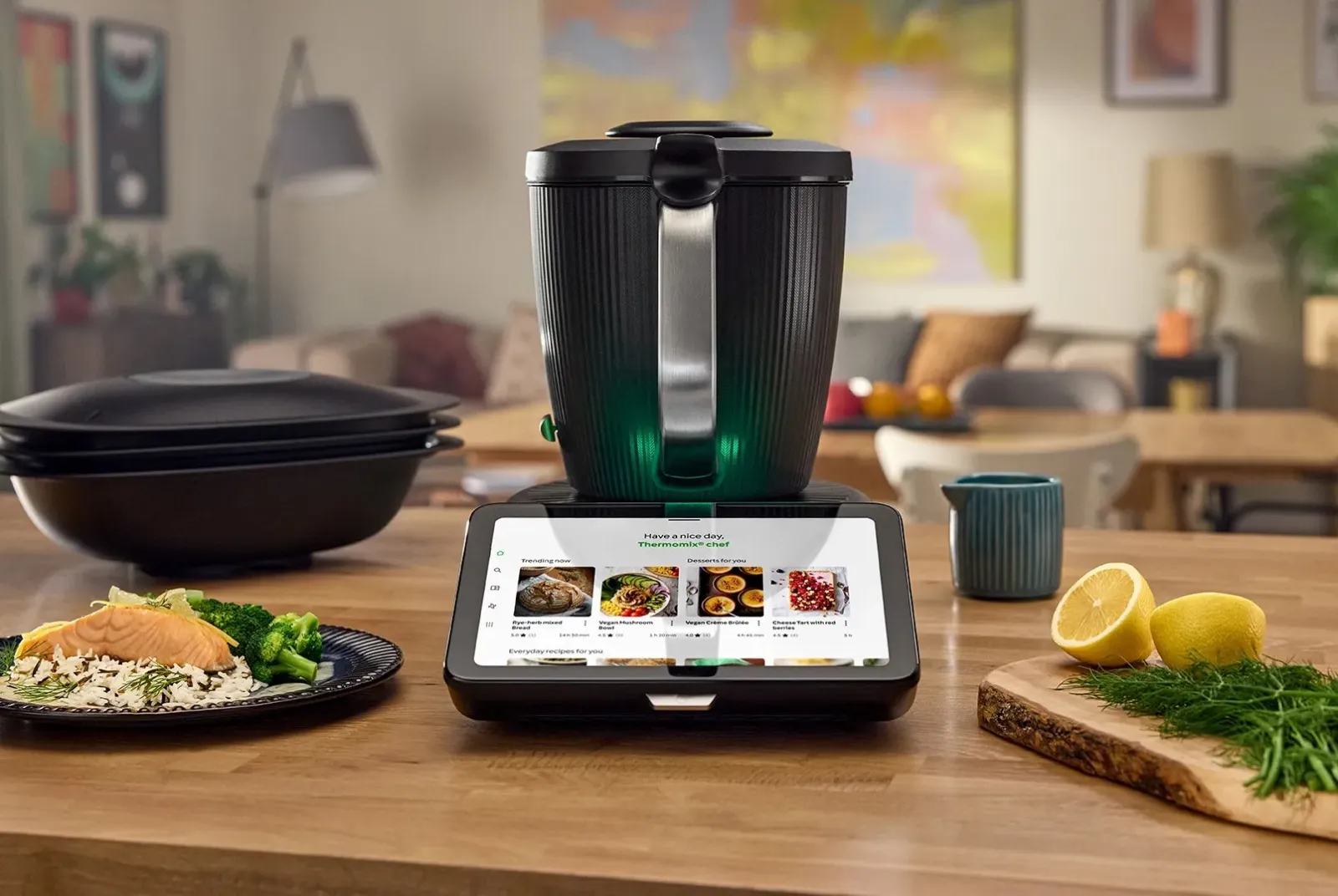
The Thermomix® TM7 combines weighing, chopping, blending, kneading, steaming and cooking in one machine. Its guided recipes handle the sequence: they tell you what to add and when, while the machine sets the timing, heat and stirring.
The motor runs from about 40 to 10,700 RPM, according to Thermomix's published TM7 speed specifications. Speed 10 reaches about 10,200 RPM, and Turbo mode reaches up to 10,700 RPM, as those specifications explain. The same source says that when the mixing bowl temperature exceeds 140°F, the motor may not increase speed immediately. Hot contents can limit how quickly the machine spins.
What Each Setting Does
Browning mode reaches temperatures up to 320°F, according to Thermomix's official TM7 overview. Open Cooking lets food cook with the lid off while the blade stays still, useful for a reduction you want to watch. Other listed functions include slow cooking, rice cooking, boiling water, reheating, sugar stages and short Turbo bursts.
Varoma is the steaming setting, not a temperature. Water boils at 212°F, so a steaming instruction refers to the mode on screen rather than a temperature you dial in. Thermomix advises a maximum speed of 5 while steaming, as described in its TM7 speed specifications.
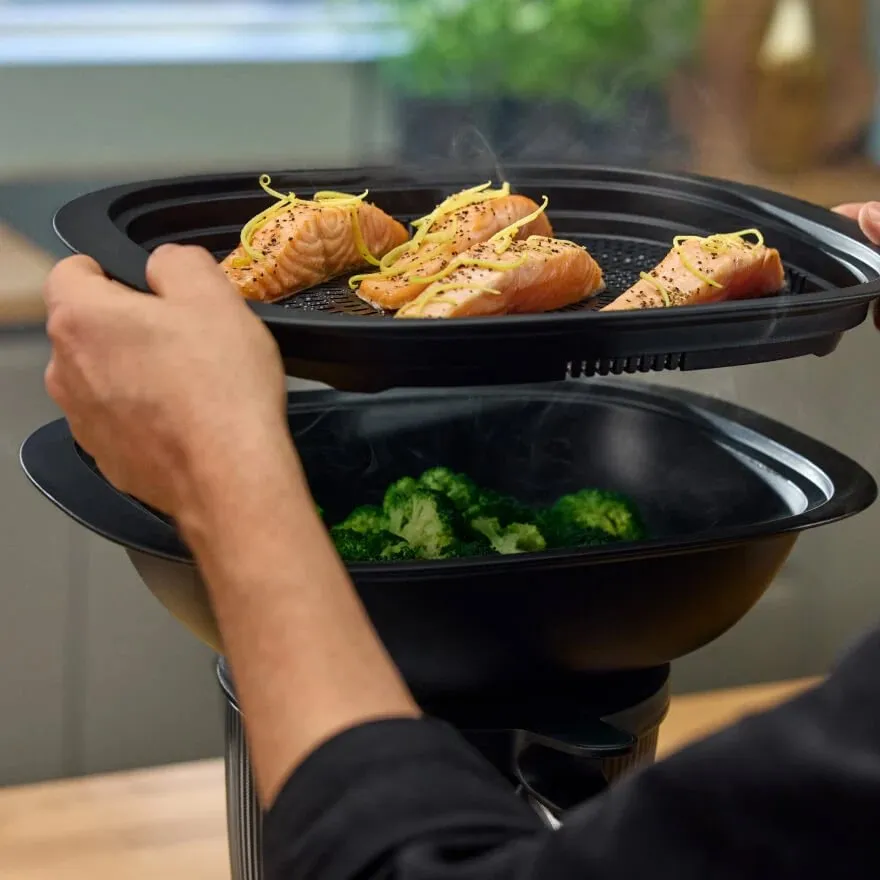
The Varoma steaming equipment sits above the mixing bowl. It has a dish, a tray and a lid. Steam from food cooking in the bowl below cooks food above it, so a recipe can combine rice or soup in the bowl with vegetables in the dish and fish or chicken on the tray. The TM7 can cook and steam at the same time, though you still decide whether the steamed food has reached the tenderness you want.
Guided recipes appear on the TM7's 10-inch screen, with the machine setting the time, heat and speed for each step. Cookidoo, the Thermomix recipe app, includes over 100,000 guided recipes. See this explanation of what Cookidoo is and how it works if you want to understand the recipe platform before using it.
Before starting, check that the recipe is marked compatible with the TM7 and follow its setup instructions. The machine handles much of the process, but it cannot make the final call on whether a dish needs more time or tastes right.
Budget and Ownership Math for Real Households
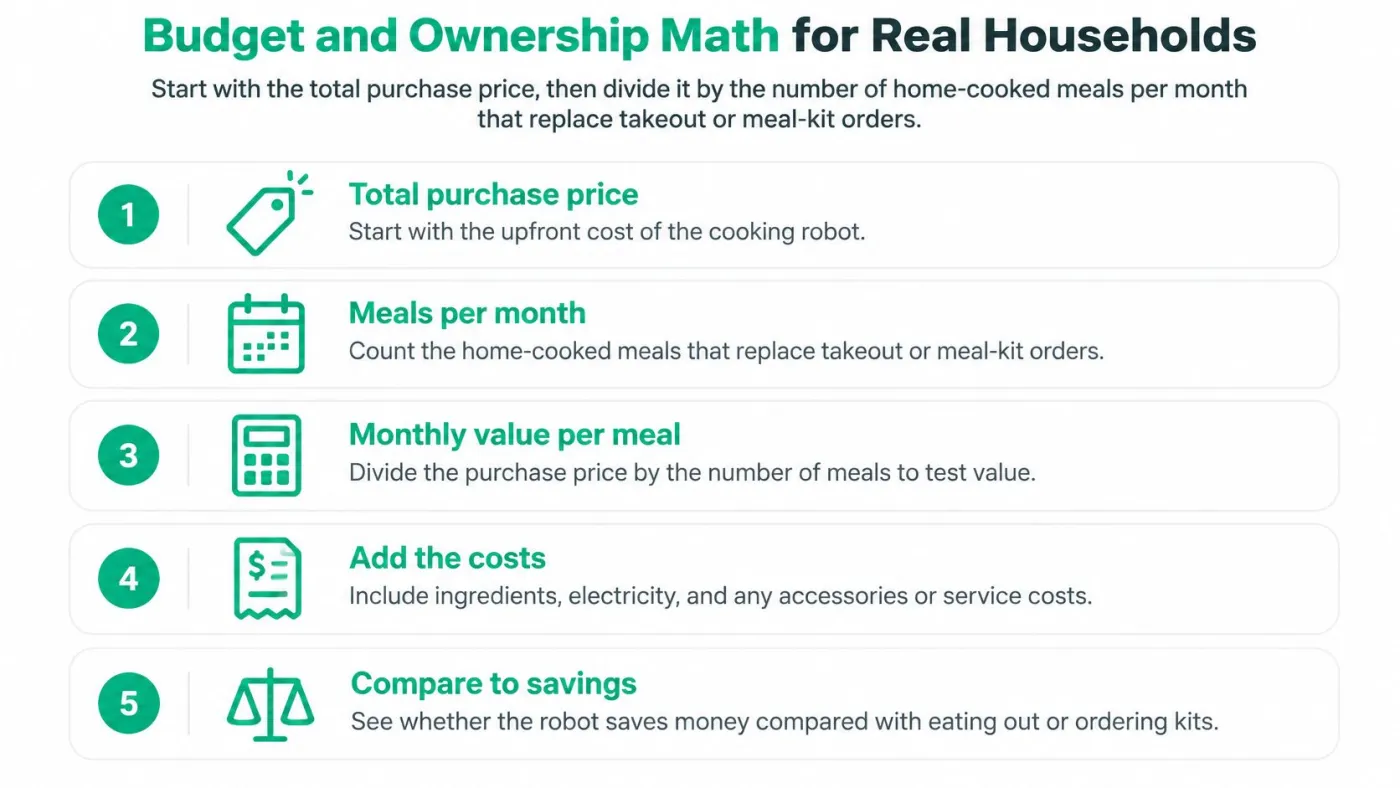
Start with the total purchase price, then divide it by the number of home-cooked meals per month that replace takeout or meal-kit orders. That single number tells you more than any feature comparison. Cook twice a week and the per-meal figure looks absurd. Cook five nights and order in the other two, and the arithmetic changes fast.
Then add the costs that never make it into the sticker price. Ingredients for meals you weren't cooking before. Electricity for long cooking sessions. Accessories you'll want once you see what the machine can do. Cleaning time, which is real time even when it's short. And the hours of learning the thing, which for many users means the first couple of weeks of picking recipes you already know how to judge.
There's also a utilization question that separates two very different buyers. A machine used several times a week earns its place on the counter. The same machine used for weekend projects sits in a cabinet by March, and no amount of capability fixes that.
The US Terms Worth Reading Twice
For United States purchases, the official Thermomix TM7 page lists a free two-year limited manufacturer warranty covering defects in materials and workmanship, with separate coverage periods for accessories and other products. It also states that a purchase may be returned within 30 days from delivery under the Vorwerk return policy, subject to conditions. You must contact customer service before returning anything, missing accessories or bundled items may be deducted from the refund, and original shipping fees are not refunded. The refund is processed after the machine arrives and its condition is assessed.
Those terms don't make the decision for you, but they do change the risk. A short return window means you should cook the meals you will eat in the first month, not the showpiece recipes.
Household | Where it fits | Check before buying |
|---|---|---|
Single adult who cooks most weeknights | Replaces repeat takeout orders | Whether you will use it several times a week |
Family of four | Weeknight dinners and batch cooking | Counter space and whether kids want to help |
Special-diet cook | Controlled ingredients and portion sizes | Whether the recipes match your restrictions |
Occasional cook | Weekend projects and special meals | Whether setup and cleanup are worth the time to you |
If a meal-kit box is your current baseline, this comparison of Thermomix with meal kits breaks down where the money goes each month.
Write these five numbers down before you decide anything.
Today's purchase price, taken from the official Thermomix website rather than an old blog post or a forum thread.
Your monthly takeout and meal-kit spend, averaged over three months of bank statements.
Home-cooked meals per week you'd realistically make, not the number you'd like to make.
Ingredient cost for those meals.
Weekly cleaning and learning time, in minutes, accurately estimated.
For number three, you can estimate your time per meal from the guided durations listed on official Cookidoo recipes, where the Cookidoo recipe listings show concrete times such as 5 minutes for Calamansi Juice, 45 minutes for a Three-in-One Meal with rice, steamed egg and steamed chicken, and 20 minutes for Hand Ripped Cabbage.
Limits, Failure Modes and Safety Habits
A half cup too much liquid, a lid that never quite clicked, a recipe written for a different machine: the TM7 will still run the time, heat and speed on the screen. It does the job it was given. The miss usually starts in the setup, while nobody is watching the bowl.
Taste, smell and a look at color and texture stay with you. The kitchen-task split already assigns those three to the cook.
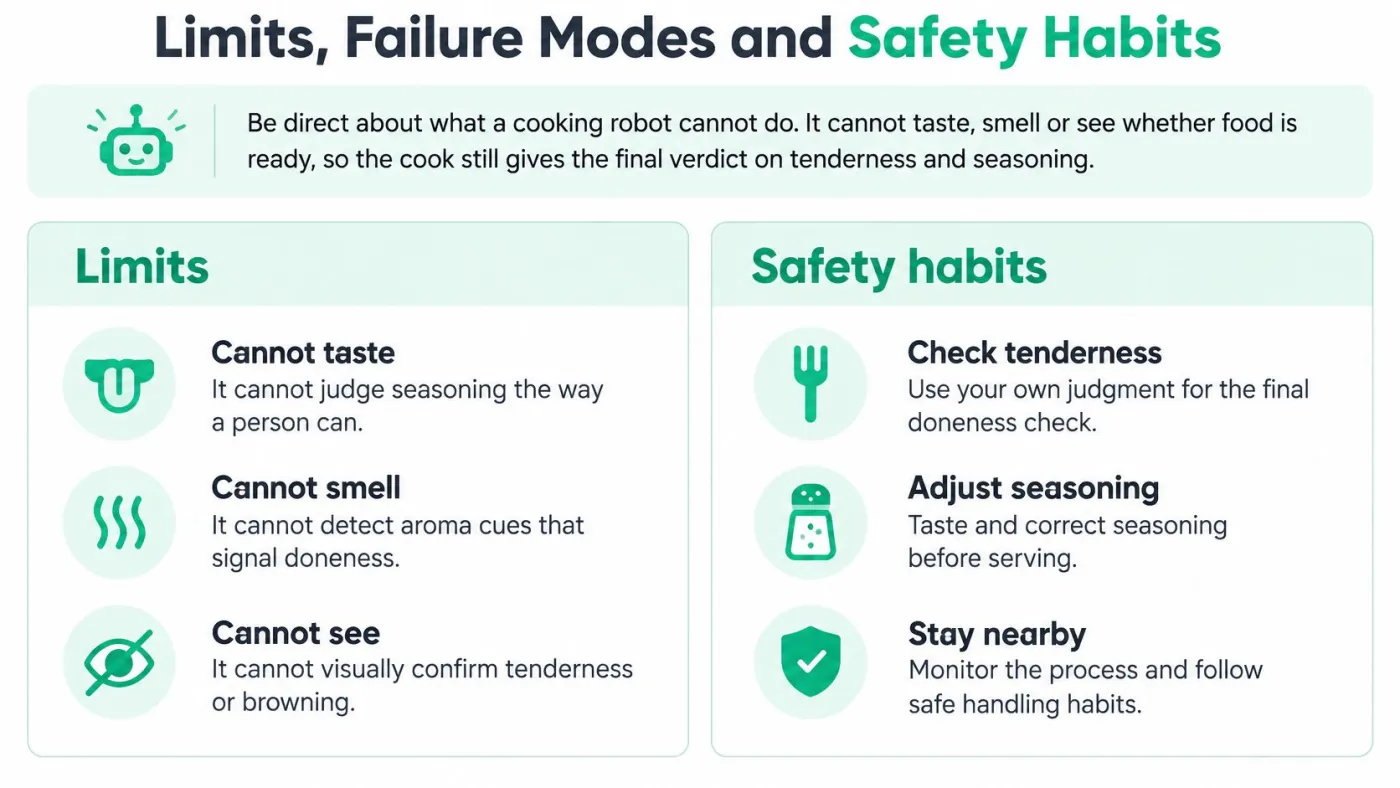
The honest version: the TM7 can handle the steaming workflow, but you still get the final vote on tenderness.
The Four Failure Points I'd Watch
A wrong amount going in. The scale reports whatever sits on it, including the extra you tipped in by accident. Salt, acid and the last pinch of seasoning are still your call. Taste before you serve, every time, while the food is hot enough to take an adjustment.
A bowl filled past its working level. Hot liquid expands and foams. Overfilling turns a smooth step into a cleanup job, so stop at the maximum fill line instead of testing how far past it you can go.
A recipe picked for a different device. Settings written for another machine or an older model will not match the TM7 in front of you. Read the device label and the setup notes before the first step.
Food left alone during a long hot step. A 45-minute simmer is a 45-minute stay-nearby job, not an errand. Stay close enough to hear the machine and to check doneness when the time ends. Steam can finish on schedule and still leave meat firmer than you want. That last bit of time is yours.
The Check Before Every Start
Ingredients weighed and ready. Measure everything and set it beside the bowl before step one.
Lid and bowl seated properly. A lid that is not locked changes how the step runs.
Recipe matches the TM7. Confirm the device and read the setup notes.
Hands and utensils clear of the blade. Use the spatula, and keep it out of a running bowl.
Home robots still carry open questions about latency, cybersecurity, privacy, data security, algorithmic bias and robot red teaming. The same body of work reported AI models failing critical safety checks and approving at least one potentially harmful command, according to a 2025 review in IEEE Consumer Electronics Magazine. Treat the connected screen as a tool, not an authority.
Be honest about which cook you are. Expect friction if you want the machine to carry your judgement as well as the heat. If you cook mostly by feel, with gear no guided recipe accounts for, plan on a learning curve. If you like to step out during a long cook, carry a timer and check the food at the points the screen suggests.
Practical rule: guided cooking is help. The machine holds the temperature. You hold the verdict on taste, seasoning and doneness.
When something goes sideways, stop. If the screen prompts a step that does not match the recipe, pause and compare the recipe with what is in the bowl. If the bowl overheats or food sticks, stop the machine, let it cool, and follow the official Thermomix guidance before you restart. A guided machine can misread a step or lose its place. Confirming each stage takes seconds.
Decide Whether a Thermomix Fits Your Kitchen
Would a guided cooking machine make weeknight meals easier in your kitchen? Start with three practical questions: Do you cook most weeknights? Would you welcome recipes that guide you through each step? Do you have counter space and time for cleanup?
If those answers are mostly yes, the Thermomix may suit your routines. If they are mostly no, a simpler tool may be a better fit. The machine can weigh, chop, cook, steam and knead, while you still taste, season and judge doneness. That division of work matters: it makes the cooking easier and leaves the final decisions with you.
The Thermomix costs $1,699. Compare that price with your monthly takeout spending using the method above. The result can help you decide whether the cost fits your household budget.
A demonstration can make the decision more concrete. IT'S A CHEF! offers free demonstrations in Las Vegas, and video calls anywhere in the USA. You can see the machine, taste the food and ask questions before deciding whether it fits your kitchen.
Prinal Glassman describes herself as a non-chef who couldn't cook before using the Thermomix. If you can follow a step on a screen, you can make dinner.
Bring your questions, your budget and your pickiest eater to a demo. Book through IT'S A CHEF! and see how the machine's guided steps fit the way you cook.