Thermomix Recipes · October 15, 2026 · 10 min read
Sushi Ginger and Wasabi at Home with TM7
You know that moment when the sushi boxes are open, the rice is still warm, and everyone at the table points at the pink ginger pile and the green blob like it's a tiny food mystery? I get it. I'm Prinal Glassman, an Independent Thermomix® Consultant in Las Vegas, and my motto is simple, “Thermomix?
On this page
- Introduction to Sushi Night Without Confusion
- What Sushi Ginger and Wasabi Actually Do
- Where Real Wasabi Comes From and Why It Is Rare
- How to Make Pickled Ginger in Your Thermomix TM7
- Real Wasabi Versus Store Wasabi and Smart Substitutes
- Simple Pairing Tips and Sushi Safety Basics
- Your Next Sushi Night Made Simple
You know that moment when the sushi boxes are open, the rice is still warm, and everyone at the table points at the pink ginger pile and the green blob like it's a tiny food mystery? I get it. I'm Prinal Glassman, an Independent Thermomix® Consultant in Las Vegas, and my motto is simple, “Thermomix? It's a chef… I'm not!” I like dinner that feels calm, not complicated, especially when busy families just want sushi night to work without waste, guessing, or a spicy surprise.
The good news is that sushi ginger and wasabi are easier to understand than they look. Ginger isn't there to decorate the plate, and wasabi isn't just there to “make it hot.” They each do a job, and once you know the job, the whole meal makes more sense.
I also like using the Thermomix® TM7™ for this kind of home cooking because it keeps the process tidy, guided, and less chaotic on a school night. If you want a broader look at what it can do, I've linked one helpful overview from my site right here: what it can do.
Introduction to Sushi Night Without Confusion
A lot of families run into the same sushi night problem. Someone wants the ginger, someone else piles wasabi into soy sauce, and one person insists the green stuff is “for flavor” while another treats it like a dare. By dessert, half the tray is untouched and the other half is a science experiment.
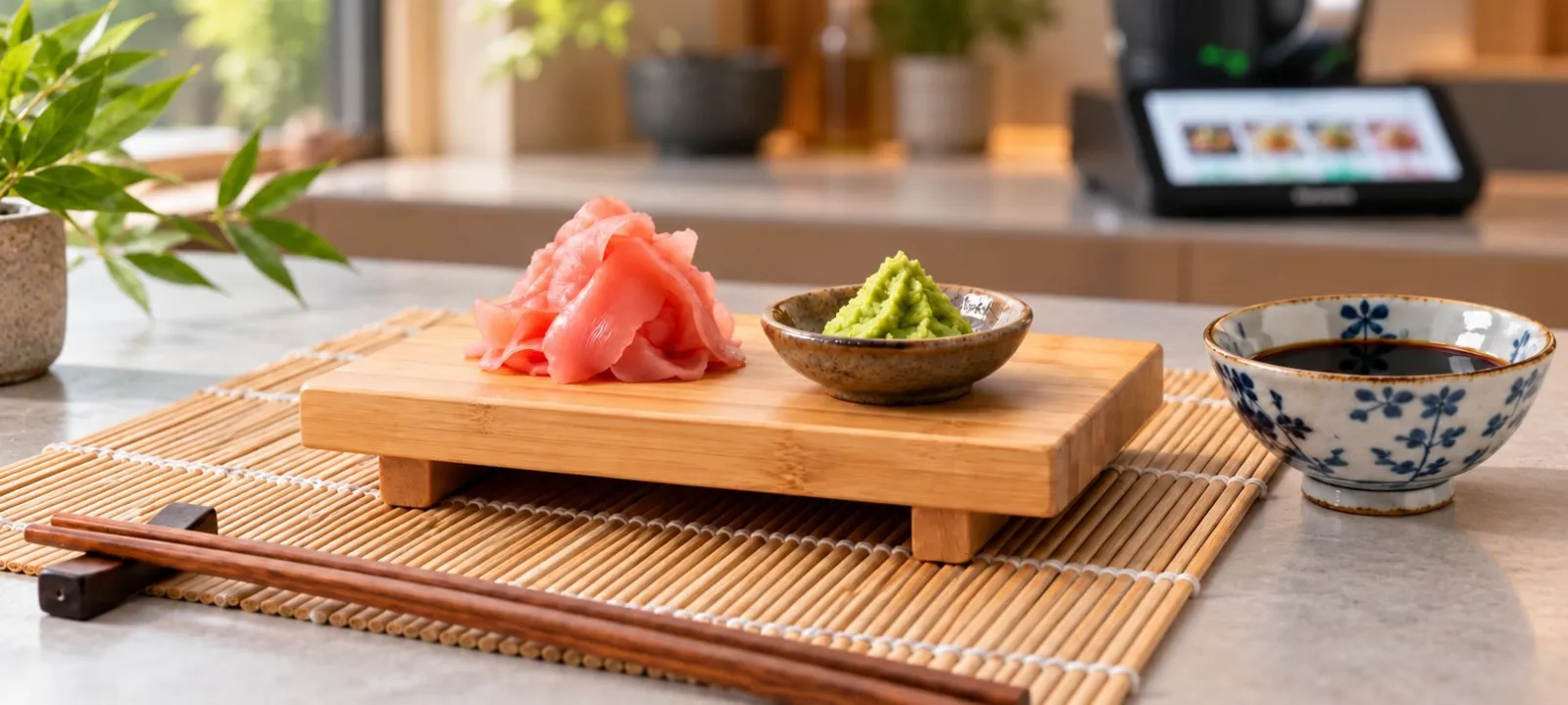
I keep it simple. Gari, the pickled ginger, is the palate reset. Wasabi is the quick, sharp heat that belongs in tiny amounts, usually with the fish and rice, not dumped all over the meal. That difference matters because one clears the way for the next bite, and the other changes the bite itself.
The history behind both condiments runs deep. Pickled ginger became part of sushi culture in Edo-period nigirizushi, with the earliest written reference in Morisada Mankō, whose compilation began in 1837 and was largely completed around 1853, according to the historical material I'm relying on for this post (source). Wasabi has an even deeper Japanese history, with archaeological evidence going back thousands of years and later ties to sushi culture that took shape much later.
For home cooks, the point isn't to turn sushi night into a museum tour. It's to know what belongs where, so you don't waste food or overpower good fish. If you've ever wondered whether that pink pile is meant to be eaten with every bite, or whether the green dab should be mixed in or tucked in, you're in the right place.
Practical rule: use ginger between bites, use wasabi sparingly, and let each one do its own job.
What Sushi Ginger and Wasabi Actually Do
Ginger works like a reset button
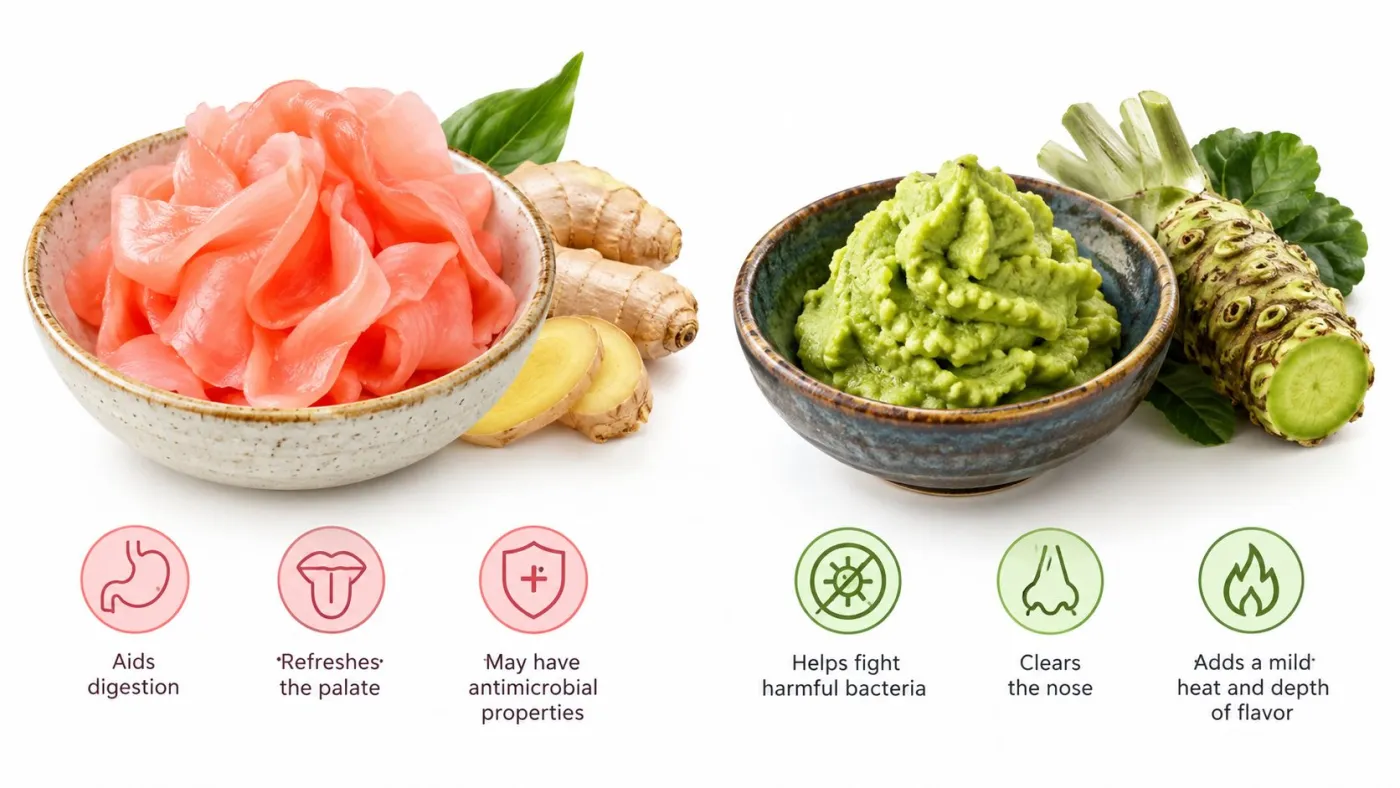
Pickled ginger, or gari, is meant to clean up your palate between bites. It's generally made from young ginger, which is sliced thin and preserved in sweetened vinegar because the young root is softer and less fibrous than mature ginger. That texture matters. It gives you a clean, crisp bite instead of a tough chew.
The easiest way to think about it is this. Ginger is the reset button. You take a bite of salmon, then a bite of tuna, then a bit of ginger, and your mouth gets a fresh start before the next flavor. That's why it's usually eaten separately, not stacked on top of the sushi like a garnish that wandered off.
Wasabi is a spark, not a sauce
Wasabi does a different job. Its heat hits fast, rises in the nose, and fades quicker than a lot of people expect. That makes it useful in tiny amounts, especially in nigiri, where chefs may place it between the fish and rice instead of offering it on the side.
That little placement detail confuses a lot of beginners. If a piece already has wasabi inside, adding a giant extra blob usually just smothers the fish. For most family tables, I tell people to think in pea-size logic, not frosting logic. You want enough for brightness, not enough to make everyone reach for water and regret their life choices.
Good sushi etiquette: taste the piece first, then add more only if you actually want more heat.
The two condiments also support each other. Ginger keeps each bite distinct. Wasabi lifts the flavor of the fish without turning the meal into a dare. That's the balance, and it's why sushi ginger and wasabi belong in conversation with the rice and seafood, not fighting them.
Where Real Wasabi Comes From and Why It Is Rare
The plant story explains the price
True wasabi comes from Wasabia japonica, and it has a long Japanese history. People were using Japanese wasabi during the Jomon period, and by the Asuka period it was valued for its pungent flavor and its perceived antibacterial and deodorizing properties, according to the Tokyo Foundation source. Its link to sushi came later, especially in the Edo period, when sushi became common as an urban prepared food.
That history helps explain why real wasabi is still special. The plant is demanding, and production stays concentrated in a few growing regions. A Japanese government publication reports that about 80% of wasabi shipped to Japanese markets is cultivated in Shizuoka Prefecture. The same publication says national output fell from about 460 metric tons in 1989 to about 220 metric tons in 2021.
Freshly grated heat behaves differently
Wasabi's kick comes mainly from volatile isothiocyanates formed when the plant is grated. Allyl isothiocyanate, or AITC, is reported as the dominant sulfur compound and can make up about 90% of wasabi volatiles (chemical source). That volatility is the whole trick. Freshly grated wasabi feels sharp and bright, then it fades.
That is why real wasabi tastes so different from a paste that has been sitting around. The sharpness is meant to be brief. If it sits mixed in water for too long, the punch weakens, so the best move is to grate or mix it close to serving and keep it cool and covered.

How to Make Pickled Ginger in Your Thermomix TM7
A sushi tray feels incomplete without gari, and homemade pickled ginger is easier than it looks. Young ginger is the right starting point. It has a softer peel, a gentler texture, and that pale, almost blushing color that makes the finished ginger look familiar. Old ginger can turn stringy fast, and nobody wants chewy sushi garnish pretending to be fancy.
For this batch, use:
8 oz (227 g) young ginger, peeled
1 cup (240 g) rice vinegar
¼ cup (50 g) sugar
1 tsp salt
2 tbsp (30 g) water
Keep clean jars ready for cooling and chilling.
Step one, prep the ginger
Slice the peeled ginger as thinly as you can. If the pieces are uneven, that is fine. You want them delicate enough to soften in the vinegar, but not so thick that they stay tough. A more even slice gives you a better texture in the end.
Add the ginger to the Thermomix® TM7™ in small batches if needed. Use the machine to chop or grate only until the slices are thin and even. Stop before it turns to mush. Sushi ginger should be crisp and tidy, not baby food with a side hustle.
Step two, heat the vinegar mixture
Add the rice vinegar, sugar, salt, and water to the TM7 bowl.
Cook for 4 min / 212°F / speed 1 until the sugar and salt dissolve. Scrape down if needed, then cook for 1 min / 212°F / speed 1 more so the mixture is fully combined.
Step three, combine and cool
Pour the hot vinegar mixture over the ginger in a clean bowl or jar. Stir gently so every piece gets coated. Let it cool to room temperature, then cover and refrigerate.
If the ginger turns lightly pink, that is lovely. If it does not, that is fine too. The color depends on the ginger itself, and homemade gari can taste right even when it looks paler than the packaged version.
Step four, store and serve
Chill the ginger for at least a few hours before serving. The flavor settles, the texture tightens up, and the vinegar softens the sharp edge of the raw ginger. It keeps best in the refrigerator in a sealed container.
Family note: if the ginger tastes too sharp, let it chill longer. If it tastes too soft, your slices were probably too thick.
I keep this recipe on rotation because it fits a busy sushi night. The TM7 handles the mixing and heating cleanly, and I can move straight into rice, fish, and all the little side dishes without turning the kitchen into a science experiment. If you want more ideas that use the same machine, browse the Thermomix recipes section.
Real Wasabi Versus Store Wasabi and Smart Substitutes
Read the label first
The green paste sold with sushi is often a blend of horseradish, mustard, starch, coloring, and a smaller amount of actual wasabi. That does not make it bad. It just means the color alone tells you very little.
Look at the ingredient list and the texture next. Real grated wasabi usually looks a little muted, not neon, and it feels less uniform. Even then, label-reading is the safer habit. For more practical kitchen checks like this, see my tips and how-to guides.
Mix for flavor, not for fear
Grating releases volatile compounds, especially AITC, and that freshness is why the flavor fades fast. So if you are making a homemade condiment, mix it close to serving instead of letting it sit around like a forgotten science fair project.
Option | What It Is | Heat Style | Best Use |
|---|---|---|---|
Real Wasabi | Fresh grated Wasabia japonica rhizome | Short, sharp, fast-fading | Special servings, delicate fish |
Prepared Store Paste | Often horseradish-based blend with coloring and starch | Brighter-looking, less nuanced | Everyday sushi night |
Homemade TM7 Style Condiment | A blended home condiment made from labeled ingredients | Adjustable, convenient | Family tables and budget-friendly meals |
Some people worry that imitation wasabi is unsafe. That is the wrong question. The right question is what it contains, how it tastes, and whether it fits the meal. Honest labeling beats guessing every time.
I will also say this plainly, because it saves table arguments. The TM7 can weigh, chop, and blend ingredients for a homemade condiment, but it cannot turn ordinary horseradish into authentic Japanese wasabi. It can help you make a sensible family version, and that is useful. It just is not magic.
Practical rule: if you want authenticity, read the ingredient list, not the shade of green.
Simple Pairing Tips and Sushi Safety Basics
Pair the condiments with the food, not against it
For salmon and tuna, I like a small touch of wasabi and a bite of ginger between pieces. Shrimp and tamago usually need less heat, so the ginger often does more work there. Cucumber rolls can handle either condiment lightly, but they're easy to overpower, so I stay gentle.
For cooked items, the condiments are even more flexible. Ginger keeps richer flavors from piling up, and wasabi can wake up a mild roll without burying it. With kids, I keep the wasabi on the side and use ginger as the calmer option.
Keep the safety basics separate from the flavor basics
Raw fish safety depends on handling, not on a spicy condiment. FDA guidance identifies three accepted freezing approaches for fish intended to be served raw, including freezing and storing at -4°F or below for at least 7 days, or freezing at -31°F or below under the other accepted time-and-temperature conditions (FDA guidance via Cleveland Clinic summary). Freezing can help control parasites, but it doesn't kill every harmful microorganism.
Food should also stay cold. FDA information says seafood that will be eaten within 2 days should be refrigerated at 40°F or below (FDA seafood guidance). For cooked seafood, 145°F is the safe target, and acidified sushi rice can help lower pH, but that doesn't replace hygienic handling or proper refrigeration. The TM7 can cook and season the rice, make the ginger, and mix a condiment, but it can't verify a supplier's raw-fish handling.
If you want the simplest family rule, here it is. Use ginger to refresh. Use wasabi in tiny amounts. Keep raw fish cold, and choose cooked fillings when that's the easier fit for the night.
Your Next Sushi Night Made Simple
You don't need to be a sushi expert to serve a smarter dinner at home. Once you know that gari resets the palate and wasabi adds brief heat, the table makes more sense. Once you know that true wasabi is rare, you can shop with calmer expectations and stop letting a bright green paste boss you around.
The nice part is that the TM7 keeps the hands-on work tidy. It can help you make pickled ginger, mix a family-friendly condiment, and handle the rice side of sushi night without turning the kitchen into a mess. That's a win in my book.
If you want hands-on help choosing a TM7, planning a first meal, or making sushi-night basics feel easier, IT'S A CHEF! offers demonstrations, purchase guidance, and ongoing support for home cooks across the United States. Visit IT'S A CHEF! and take the next step toward a calmer, better-organized kitchen.