Thermomix Recipes · October 24, 2026 · 13 min read
Inverted Sugar Syrup Recipe: Make It in Your Thermomix®
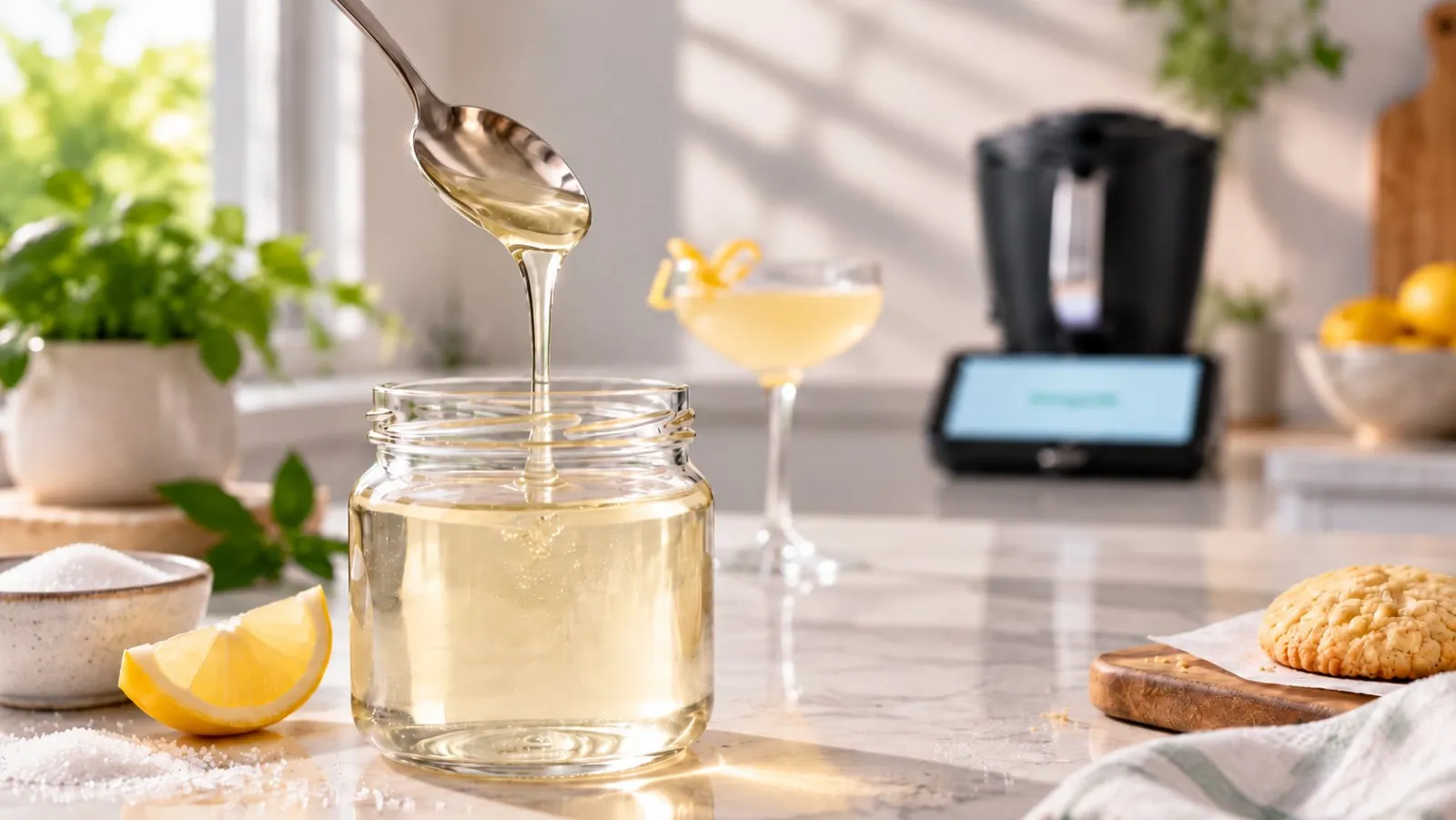
You're halfway through a cookie recipe when you spot it: inverted sugar syrup. Not the sugar in your cupboard. Not quite the simple syrup you might use in a drink. Just an ingredient name sitting there as though everyone keeps a jar beside the peanut butter.
On this page
- Why Inverted Sugar Syrup Belongs in Your Kitchen
- Choosing How to Make Inverted Sugar at Home
- Making Inverted Sugar Syrup in Your TM7
- Fixing Grainy Syrup and Adjusting for Batch Size
- Using Inverted Sugar in Baking and Cocktails
- Storing Inverted Sugar Syrup Safely
- Your Next Batch and a Practical Starting Point
You're halfway through a cookie recipe when you spot it: inverted sugar syrup. Not the sugar in your cupboard. Not quite the simple syrup you might use in a drink. Just an ingredient name sitting there as though everyone keeps a jar beside the peanut butter.
You don't need a pastry qualification to understand it. You do need to separate the sugar science from the tempting idea that any sweet liquid cooked long enough will do. That distinction matters when you're adapting an inverted sugar syrup recipe for your TM7.
Why Inverted Sugar Syrup Belongs in Your Kitchen
Ordinary table sugar is sucrose. Making invert sugar means splitting sucrose into its simpler sugars, glucose and fructose, through a reaction called hydrolysis. Water participates in that reaction, and the resulting sugars occur in approximately equal molecular amounts, as described in the chemistry of inverted sugar syrup.
That's the technical explanation. The kitchen explanation is more useful: you're changing how the sugar behaves, not merely dissolving it.
Invert syrup can help retain moisture and discourage unwanted crystallization. That makes it useful when you want a soft cookie, a smooth filling, or a sweetener that's already liquid when friends arrive for drinks.
Think texture before sweetness
A cookie that should stay soft has different needs from a biscuit meant to snap. A smooth filling has different needs from a confection whose texture depends on controlled crystals. Invert syrup belongs in the recipes where its particular behavior helps.
It isn't a universal upgrade. Adding it without considering the rest of the recipe can change the result in ways you didn't intend.
For softer textures: Consider recipes where moisture retention is welcome.
For smoother sugar mixtures: Look for applications where graininess is a problem.
For deliberate crunch: Don't assume a moisture-retaining ingredient is your friend.
For predictable results: Start with a recipe that already accounts for syrup.
A home cook's approach
I'm Prinal Glassman, an Independent Thermomix® Consultant in Las Vegas, helping families across the USA. My motto is simple: “Thermomix? It's a chef… I'm not!”
I don't run cooking classes, and I won't dress an untested syrup formula up as a dependable machine recipe. Sugar is perfectly capable of providing enough drama without my assistance.
My approach is to choose a suitable method, understand the measurements, and keep texture questions separate from safety questions. You should know why a batch becomes grainy, what changes when you scale it, and when a storage claim deserves a raised eyebrow.
Choosing How to Make Inverted Sugar at Home
You have a practical choice between buying a finished product, using invertase, and using food acid with heat. None deserves a gold star for being more complicated.
The useful question is: How much process control do you want to take on?
Approach | When it makes sense | The trade-off |
|---|---|---|
Buy a finished invert syrup | You need a specified ingredient without developing a process | You follow the product's formulation and storage directions |
Use invertase | You want to work with enzyme-controlled inversion | Temperature and acidity require careful attention |
Use food acid and heat | You want a straightforward culinary route | Acid, concentration, heating, and evaporation still need coordination |
Where the enzyme route gets fussy
Invertase is an enzyme that promotes the splitting of sucrose. Technical culinary guidance describes operation around 86°F to 113°F, at approximately pH 4.6, while excessive heat can denature the enzyme, according to the food-science guidance on sugar preparation.
That makes the enzyme route different from adding an ingredient and heating until the syrup looks right. The conditions must suit the enzyme.
For a standard home batch, food acid and heat are generally the simpler route. Lemon juice, citric acid, or cream of tartar can provide the acid, but they aren't automatically interchangeable spoon for spoon.
Choose the process you can actually verify
A pH measurement helps describe acidity. A Brix measurement helps track soluble-solids concentration. Neither measurement, by itself, tells you everything about the finished syrup.
A timer is useful only when the formula and operating conditions are already established. It can't correct an unknown acid dose or compensate for a different amount of evaporation.
Practical rule: Buy the syrup when you need a specified ingredient immediately. Choose a tested acid-and-heat recipe when you want to make it. Choose enzymes when you're prepared to manage their operating conditions.
If you're deciding whether the machine suits your kitchen, I offer friends-night demonstrations in Las Vegas, and anywhere else in the USA I can show you the Thermomix on a video call. You can see the workflow and discuss what you want to cook before committing to a purchase.
That's a demonstration, not a promise that every recipe found online transfers unchanged into the bowl.
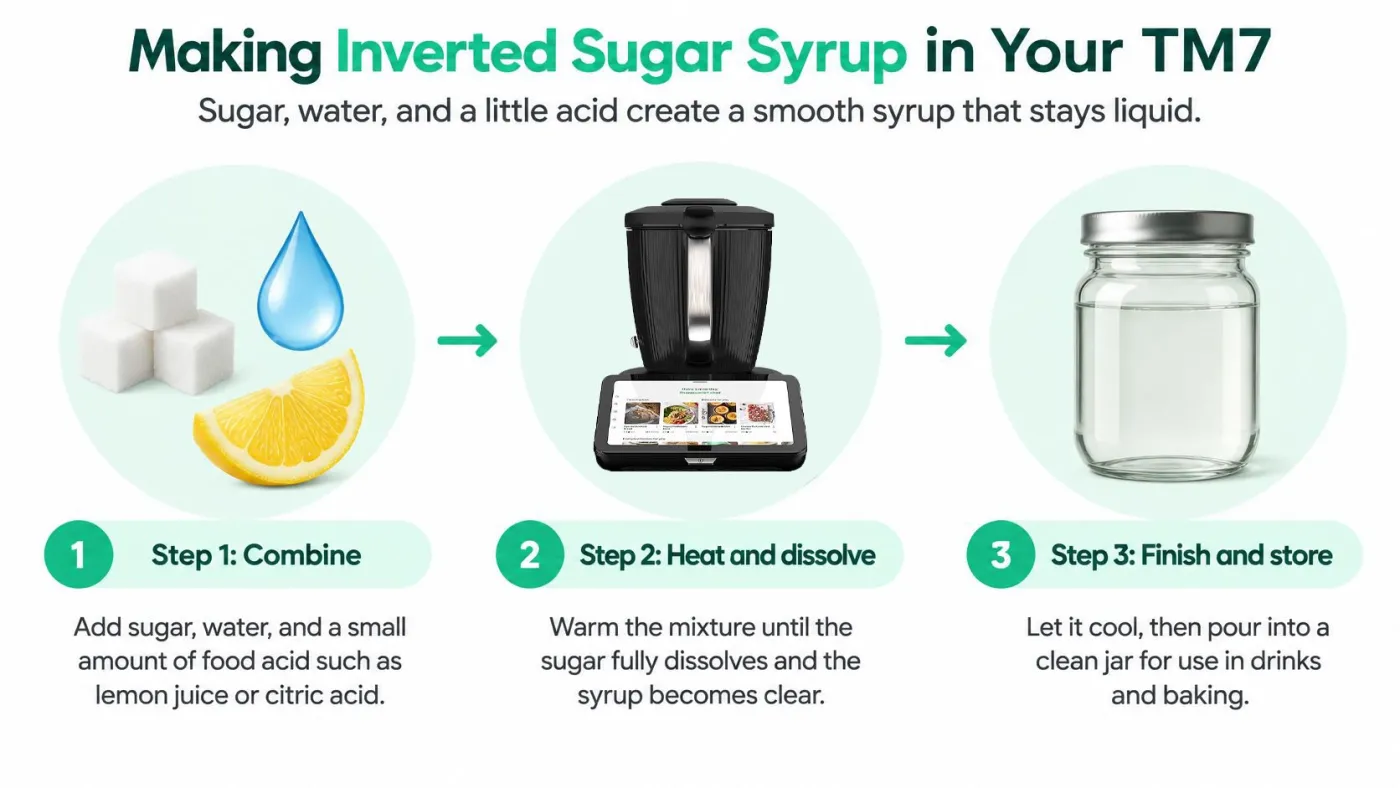
Making Inverted Sugar Syrup in Your TM7
The ingredient list looks reassuringly short: sugar, water, and a small amount of food acid. The missing detail in many adaptations is whether the formula and machine settings have been tested together.
The Thermomix® TM7™ weighs, mixes, and cooks in the same bowl. That's helpful for a measured process, but it doesn't establish an acid dose, inversion endpoint, or storage period for an improvised formula.
There isn't a validated TM7 formula with ingredient weights and time, temperature, and speed settings in the supporting material for this guide. I won't invent those settings or present a general sugar-processing benchmark as a tested appliance recipe.
Start with a complete formula
Before loading the bowl, choose a machine-specific recipe that states the sugar, water, and acid amounts, plus the operating settings for every phase. Ingredient quantities should include US measures with gram weights in brackets, so you can reproduce the batch by weight rather than guess from a loosely filled cup.
A complete recipe needs to identify:
The acid: Its type and measured amount, not “a squeeze.”
The starting concentration: How much sugar is present relative to water.
The operating sequence: Time, temperature, and speed for each machine phase.
The endpoint: What measurement tells you to stop.
The storage directions: Conditions and a stated use period appropriate to that recipe.
You can browse my Thermomix recipe collection for cooking ideas, but don't assume a general recipe collection validates a syrup formula.
Dissolve before sustained processing
The first phase is complete dissolution. Use the selected recipe's gentle heating and mixing instructions, and check that visible crystals have disappeared before continuing.
Don't scrape dry sugar from the bowl walls into a finished batch. If crystals remain above the liquid, stop and deal with them according to the recipe and the machine's handling instructions before proceeding.
Technical process descriptions discuss starting formulations around 65 to 75° Brix and show how acidity, temperature, mixing, and residence time work together. The same invert-sugar processing reference reports complete hydrolysis at 176°F, pH 3.0, and approximately 30 minutes under intensified mixing.
Those are process conditions, not a TM7 program. They don't supply a home acid quantity or a machine speed.
Measure the finish rather than guessing
A refractometer gives a more repeatable concentration check than deciding the syrup looks “about right.” Follow its measurement instructions and use the target specified by your chosen recipe.
Remember that Brix is not a direct test of how much sucrose has inverted. It helps you track concentration; it doesn't replace the rest of the process.
The machine handles the prescribed heating and stirring while you check the result. Stop at the established endpoint rather than extending the cook because the warm syrup seems thin. Continuing to evaporate water can produce an overly thick or browned batch.
The honest starting point is a complete, tested machine recipe. A short ingredient list isn't permission to fill in the missing settings.
Fixing Grainy Syrup and Adjusting for Batch Size
“Never stir sugar syrup” sounds reassuringly decisive. It also leaves out the part where controlled mixing helps dissolve the sugar.
Mixing during dissolution and agitation during cooling aren't the same thing. Treating them as though they are can leave you with undissolved crystals at the beginning and unnecessary movement at the end.
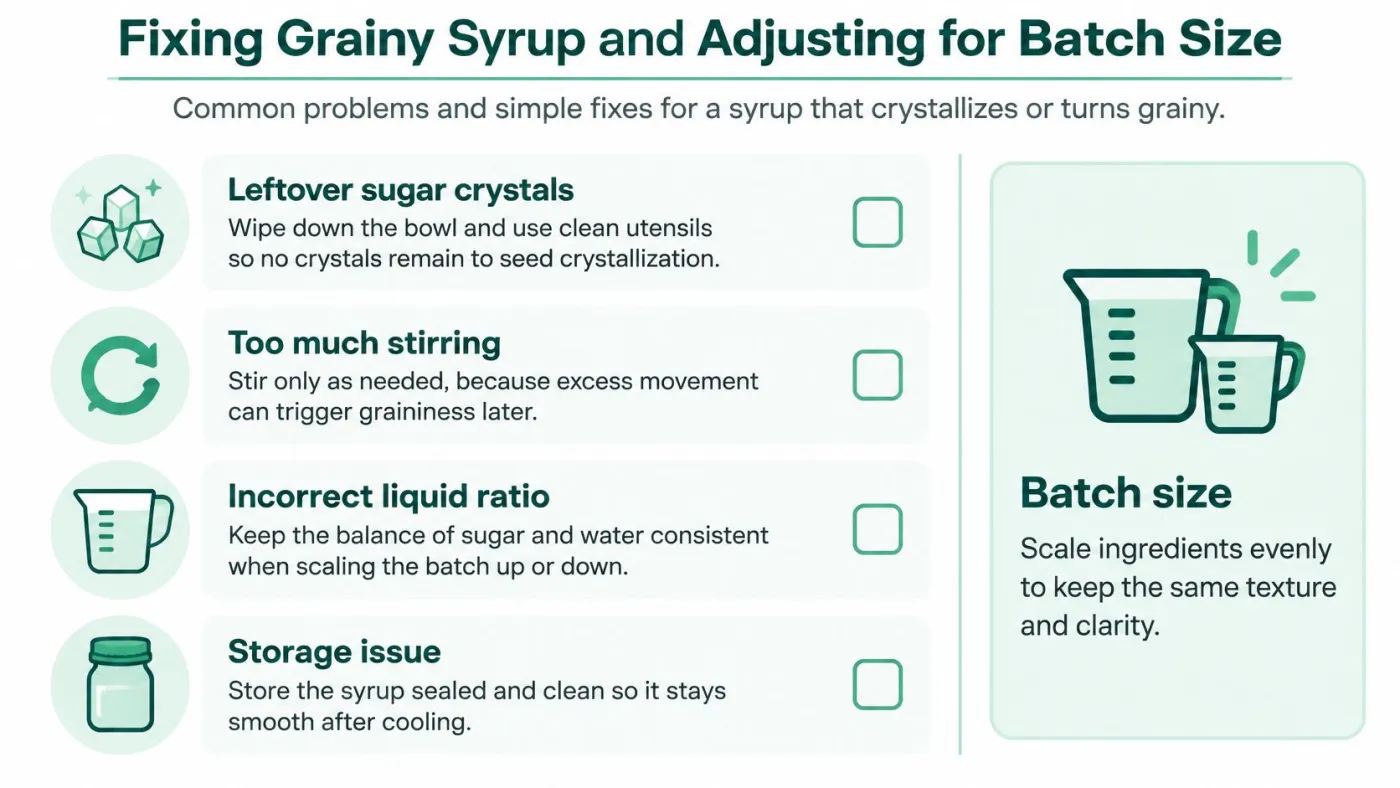
The practical guidance on preventing crystallization in invert syrup emphasizes complete dissolution and removing residual crystals. A batch can reach its intended temperature and still develop graininess if crystals remain to seed further crystallization.
Diagnose the sequence, not just the thermometer
Look back through the batch. Was the sugar fully dissolved? Did dry sugar remain on the bowl walls? Was the cooling syrup stirred or shaken? Did extra heating remove more water than intended?
Insufficient inversion is another possibility. A clear syrup is not proof that the desired conversion occurred.
If the cooled syrup is grainy, don't immediately add water and restart an improvised heating cycle. That changes the formula again without telling you what caused the original problem.
A correct temperature reading can't undo crystal contamination or tell you that an unknown acid dose was suitable.
Scaling ingredients isn't scaling cooking time
Weigh ingredients when changing batch size, and preserve the formula's proportions. Follow the machine's applicable operating limits rather than assuming that a larger batch takes longer.
Evaporation is the awkward part. A changed batch size may lose a different proportion of water during the same programmed interval, so multiplying the ingredients doesn't establish the new processing time.
Use a tested batch size whenever possible. Record the ingredient weights, concentration checks, and cooling behavior if you're comparing results.
My tips and how-to collection is a useful place to keep building those practical habits.
For a grainy batch, check:
Dissolution: Were visible crystals gone before the main processing phase?
Bowl sides: Were residual crystals addressed without scraping them into finished syrup?
Evaporation: Did extra cooking overconcentrate the mixture?
Cooling: Was the syrup disturbed unnecessarily?
Formula: Was the acid amount established, rather than guessed?
Using Inverted Sugar in Baking and Cocktails
Think of invert syrup as a functional ingredient, not a replacement for every spoonful of sugar in the kitchen.
For weekend cookies, the useful question is whether you want a softer result. For a filling, it may be whether you want to discourage graininess. For a cocktail, the attraction is having a liquid sweetener ready to incorporate.
Use the formulation range in its proper context
Confectionery guidance identifies approximately 10% to 15% invert sugar in the finished sugar mixture as a typical range for producing a noncrystalline product. A broader testing suggestion is to replace roughly 25% to 50% of a recipe's sucrose when exploring its effects, according to the sugar-syrup formulation guidance.
Those figures describe different formulation decisions. They are not interchangeable instructions, and neither means “replace all the sugar.”
There's another important distinction: syrup weight includes water. Replacing dry sugar with the same weight of syrup changes more than the sweetener.
For a beginner, a recipe already developed with invert syrup is easier to interpret than a spontaneous substitution. You'll have fewer moving parts when judging the result.
Match the ingredient to the desired finish
For soft cookies, use a dough formula that already includes the syrup. Let the machine make the dough, then bake it in the oven as directed. Judge the cooled cookie, not just the warm one.
For frostings and fillings, smoothness may be welcome, but structure still matters. More syrup isn't automatically better if the finished mixture becomes softer than you need.
Fondant-style work is especially sensitive to the intended texture. Follow the actual formula rather than borrowing a substitution percentage from an unrelated dessert.
Soft cookies: Look for a formula designed around moisture retention.
Fillings and frostings: Balance smoothness against the firmness you need.
Fondant-style preparations: Respect the recipe's intended sugar structure.
Drinks: Adjust the sweetener to the finished drink rather than assuming all syrups taste equally sweet.
My vegan royal icing guide is a separate decorating resource. It isn't permission to add invert syrup to icing that needs to set in a particular way.
For friends-night cocktails, begin with a drink formula that specifies the sweetener. If you're adapting it, taste as you adjust and keep a record of what you changed.
The goal isn't to prove the syrup belongs everywhere. It's to use it where the texture or handling benefit is worth the adjustment.
Storing Inverted Sugar Syrup Safely
A jar can look beautifully clear and still lack a validated storage life. That's why I separate quality from food safety.
Quality asks whether the syrup has the texture and flavor you want. Safety asks whether its formulation, handling, packaging, and storage conditions adequately control hazards. Those aren't interchangeable questions.
High sugar concentration alone doesn't establish safety. Water activity, acidity, sanitation, packaging, and storage temperature also matter, as explained in this discussion of invert-sugar storage and stability.
A commercial label isn't a homemade guarantee
An unopened commercial product may have room-temperature storage directions. That guidance applies to that manufacturer's formulation and packaging, not automatically to your homemade batch.
Refrigeration can encourage crystallization in some formulations. That's a possible quality trade-off, not a reason to leave an unvalidated homemade syrup on the counter.
The storage considerations for invert sugar also distinguish concentration from a guaranteed shelf life. A cooking endpoint doesn't establish how long every homemade variation remains safe.
Keep handling straightforward
Cool and refrigerate: Follow the recipe's cooling directions, then refrigerate the clean, sealed batch.
Use clean utensils: Avoid introducing crumbs or other food into the jar.
Label the date: Record when you made it and the recipe you followed.
Follow the stated period: Don't borrow a months-long claim from a different formula.
Discard suspicious syrup: Mold, fermentation, gas, off-odors, or unexpected separation are reasons to discard it.
Cooling before refrigeration is a handling step, not proof of preservation. Likewise, automated heating can make a process repeatable without validating sanitation or shelf life.
Storage boundary: If your recipe doesn't establish a storage period, don't invent one because the syrup contains plenty of sugar.
Crystallization alone concerns texture. It doesn't certify safety, and the absence of crystals doesn't certify it either. Keep those judgments separate.
Your Next Batch and a Practical Starting Point
The most useful next step may be smaller than making a jar today. It may be finding a complete machine-specific formula before you buy ingredients.
That isn't being timid. It's avoiding the frustrating situation where the syrup looks lovely, but you don't know its concentration, how much inversion occurred, or how to store it.
Make your starting point reproducible
A dependable inverted sugar syrup recipe should let you repeat the process without translating vague phrases into guesses. “A little acid” explains an ingredient's role. It doesn't provide a reproducible dose.
Keep the decisions manageable:
Choose the method: Buy a specified product or follow a tested machine recipe.
Check the formula: Look for ingredient weights and complete operating settings.
Use the endpoint: Measure what the recipe asks you to measure.
Protect the result: Follow its crystal-control and cooling directions.
Use it deliberately: Choose a compatible baking or drink formula.
Store it responsibly: Follow the handling instructions and stated storage period.
You don't need to become a sugar scientist. You do need enough information to distinguish a recipe from an experiment.
Get help with the machine before improvising
For Las Vegas home cooks, I offer in-person friends-night demonstrations for small groups. For families elsewhere in the United States, I can show you the Thermomix on a video call and answer questions as we go.
Those sessions are a chance to discuss the foods you make and see the machine's workflow. If your main concern is baking, meal planning, or getting dinner started without ordering takeout again, say so. The demonstration should help you evaluate your own kitchen needs.
After purchase, a first-meal setup session helps confirm connectivity and basic workflows. New Thermomix purchases include three months of Cookidoo access to guided recipes, and I can help with questions afterward.
I'm still an Independent Thermomix® Consultant, not a chef with a secret sugar certificate. My job is to help you understand the machine and make informed choices, including recognizing when a recipe needs better information before you press start.
A smooth syrup is satisfying. Knowing why it worked, and how to handle it afterward, is more useful than a jar made by guesswork.
At IT'S A CHEF!, I offer friends-night demonstrations in Las Vegas, video calls anywhere in the USA, and first-meal setup support after purchase. If this syrup has you wondering how to evaluate a machine recipe or whether the TM7 fits your cooking, book a demo or send me your question.