Thermomix Recipes · October 3, 2026 · 8 min read
Vegan Royal Icing: Whipped Perfectly in the Thermomix TM7
I've had that moment in the kitchen where the cookies are cooling, the piping bag is ready, and the frosting looks just a little too moody to trust. If you've ever stared at a bowl of vegan royal icing and wondered whether it'll set, spread, crack, or betray you in front of an entire tray of sugar cookies, you're my kind of baker.

On this page
I've had that moment in the kitchen where the cookies are cooling, the piping bag is ready, and the frosting looks just a little too moody to trust. If you've ever stared at a bowl of vegan royal icing and wondered whether it'll set, spread, crack, or betray you in front of an entire tray of sugar cookies, you're my kind of baker. The good news is that vegan royal icing isn't some mysterious specialty trick, it's an old decorating medium with a modern plant-based twist, and it behaves a lot better when the Thermomix TM7 does the heavy lifting.
Royal icing itself has a long paper trail, with documented mentions going back to 1770 in Borella's Court and Country Confectioner and historical accounts placing its development in the early 18th century; piping with it became more common in the 1840s (Royal icing history). That history matters to me because it reminds us that vegan royal icing isn't a fad, it's a practical adaptation. The old version leaned on egg whites, the vegan version leans on aquafaba, and the TM7 gives that chickpea liquid the kind of controlled whipping that turns “Will this work?” into “Oh, that's nice.”
Why Vegan Royal Icing Is Easier Than You Think
The first time I made vegan royal icing by hand, I kept checking the bowl like it had personally insulted me. It looked fine, then too loose, then suddenly too stiff, which is a very glamorous way to lose confidence before dessert even leaves the counter. The TM7 changed that rhythm for me because it keeps the whipping consistent, and consistency is the whole game when you need icing that sets hard and glossy.
The old worry, the new rhythm
A lot of people think vegan icing is fragile by definition. It isn't. The structure comes from aquafaba, which can whip into foam and hold shape in a way that resembles egg whites, then sugar and stabilizers build the body around that foam. That's why the TM7 is such a good fit, it makes the foam phase feel less like guesswork and more like a repeatable move.
Practical rule: if the foam stage is weak, the whole bowl feels unreliable later.
There's also a market reason this recipe keeps showing up in real kitchens. One market outlook valued the global royal icing market at USD 4.39 billion in 2025 and projected growth to USD 6.09 billion by 2034 at a 3.7% CAGR. A broader confectionery icing report put the category at USD 3.83 billion in 2025, rising to USD 6.12 billion by 2034 at 5.2% CAGR, with royal icing representing 18.3% of that market by value. That's not niche. That's a serious decorating lane.
Perfect Vegan Royal Icing Recipe in the Thermomix TM7
The first time I made vegan royal icing for a tray of cookies, I expected a bowl of disappointment. Instead, the TM7 turned chilled chickpea liquid into a smooth, glossy icing while I dealt with the sprinkles. That repeatability is the genuine advantage here. Hand-whisking can work, but the TM7 removes much of the guesswork.
For one batch, gather 3 tbsp chilled aquafaba, 1 cup confectioners' sugar, 1/8 tsp cream of tartar, 1/4 tsp xanthan gum, and 1 tbsp light corn syrup. An expert recipe notes that aquafaba contains about 1.8% protein by weight and can whip to stiff peaks, which explains why it works so well in cookie icing (recipe benchmark).
My TM7 method
Add the chilled aquafaba, cream of tartar, and xanthan gum to the TM7 bowl. Whip 30 to 45 seconds / no heat / speed 4 until foamy.
Add the confectioners' sugar gradually through the lid opening. Mix 1 minute / no heat / speed 3, saving yourself from a powdered sugar snowstorm.
Add the light corn syrup. Mix 6 minutes / no heat / speed 4 until glossy and stable.
Scrape down the bowl. If you spot sugar pockets, mix for another 30 seconds / no heat / speed 4.
Leave the icing in the bowl for a few minutes before decorating.
A tested aquafaba method also whips the mixture quickly after adding sugar, then continues mixing until the icing becomes thick and glossy (vegan royal icing method). That matches my kitchen experience. The TM7 gives the mixture enough steady mixing time to develop its body without making me stand over the bowl, whisk in hand, wondering whether it is ready.
My honest shortcut: if the icing already looks elegant, keep mixing. It may still need time to become dependable.
For another useful benchmark, one egg-free formula combines 1/4 cup aquafaba, 1/2 teaspoon cream of tartar, and 2 cups powdered sugar, then beats the icing on high for 3 to 5 minutes. Extra water or powdered sugar adjusts the final texture (egg-free vegan royal icing). I keep leftovers in an airtight container and let them return to room temperature before remixing. That small step helps the next decorating session start smoothly.
Adjusting Consistency for Flooding and Piping
I once divided a fresh bowl between cookies that needed flooding and lettering that needed a firm line. The flood raced toward the edges, while the lettering broke halfway through each word. One batch had somehow failed both jobs. With the Thermomix TM7, I can start with an even base, then adjust each portion instead of hand-whisking through lumps and guessing.
Flooding needs a slow settle
Flood icing should move, then settle neatly inside its outline. A baking source explains that royal icing forms a thin crust after 15 to 30 minutes, can remain wet underneath for several hours, and may thin again after 24 hours unless more sugar is added (royal icing drying behavior). I use that as a reminder to judge the icing on the cookie, not only in the bowl.
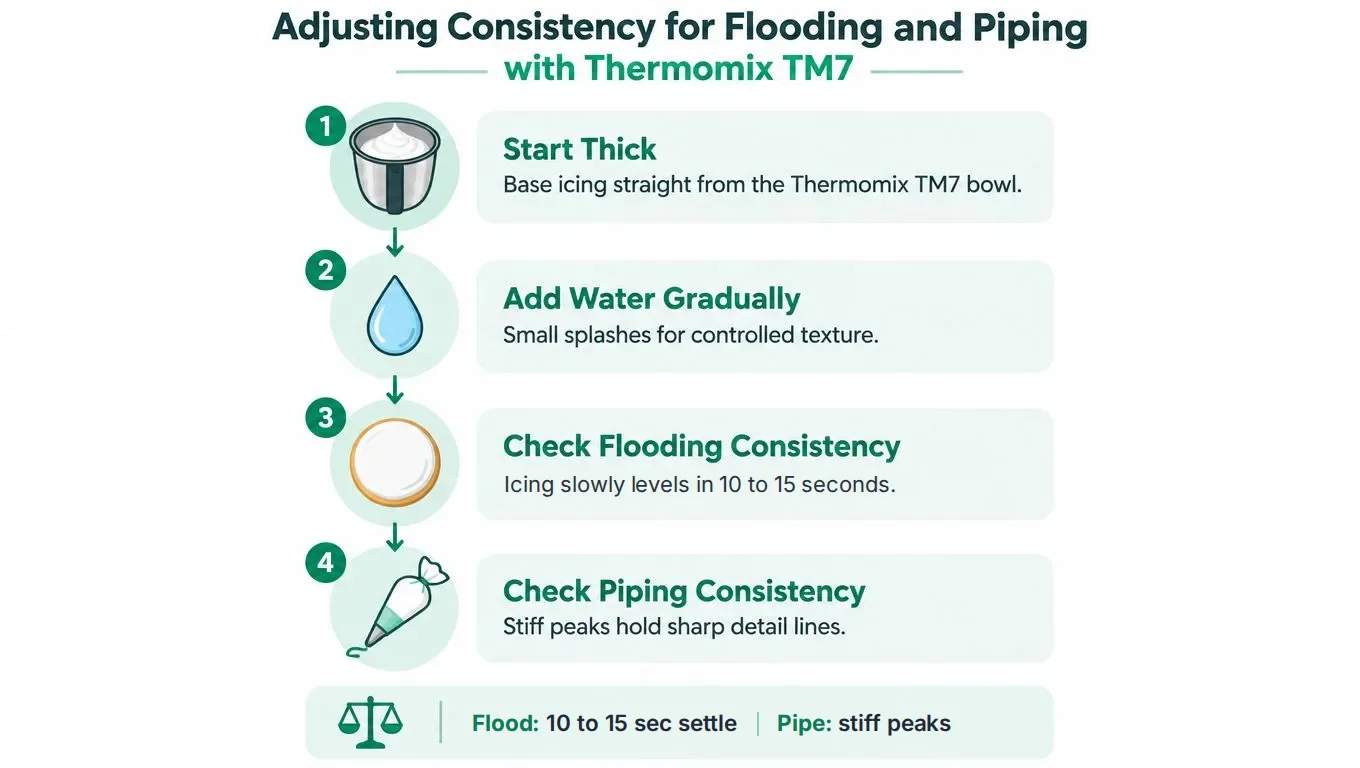
For cookie flooding, I want the icing to spread smoothly without sprinting over the edge. Drag a spoon through it and watch the track. The surface should relax in about 10 to 15 seconds. If it closes instantly, add a little confectioners' sugar. If it sits stiffly, loosen it gradually and mix until the texture evens out.
The TM7 makes those small adjustments less dramatic. I can portion the icing, make a controlled change, and keep the consistency predictable across a tray. The guide below follows the same decision path, with fewer sticky notes than my kitchen usually collects.
Piping needs stronger peaks
Outlines, lettering, and small details need icing that holds its shape. Lift the spatula and check the peak. If it folds over tiredly, mix a little longer or add more sugar. A meringue-powder substitute can work at a 1:1 substitution ratio, although some vegan versions may bleed color unless whipped thoroughly enough to build strength (meringue powder substitute guidance).
Practical rule: flooding wants flow, piping wants resistance.
Cover the bowl and rest it for five minutes after mixing so the foam stabilizes before portioning it for decorating.
Tips for Coloring and Piping with Vegan Royal Icing
The pink icing on a birthday cookie can look perfect in the bowl, then turn pale, bubbly, or loose on the cookie. I use gel color to avoid adding unnecessary liquid, and the Thermomix TM7 keeps the color mixing evenly without the hand-whisking guesswork that can weaken a batch. Strong color still needs strong structure.
Keep the color bold and the lines clean
I start with a small amount of gel color and mix it in the TM7 at a low speed. That reduces extra air, which can leave tiny bubbles along piped lines. If bubbles appear, I let the bowl sit briefly and stir gently before decorating. A short pause often saves me from chasing pinholes around an otherwise lovely cookie.
For piping, steady pressure matters as much as the nozzle. Fine lettering needs a narrow tip and firmer icing. A border needs enough body to hold its edge while I guide it into place. If the icing feels too thick, add 1 to 3 teaspoons of water gradually. If it feels too thin, add powdered sugar one spoonful at a time, using this vegan royal icing troubleshooting guide as a reference.
The TM7 makes small color and texture adjustments predictable. I can divide the icing, test one portion, and avoid turning the whole bowl into an experiment.
Storage matters more than people think
If the icing is waiting for its cookies, cover it well so the surface does not crust. One storage guide says royal icing can keep in the fridge for up to 4 weeks, although it should be whipped again before use (storage guidance). That suits holiday baking, or the evenings when decorating begins at 9 p.m. because the supposedly calm afternoon disappeared.
The TM7 gives a stored batch an even remix instead of leaving me with streaks of dense icing and pockets of air. After remixing, let it rest for three minutes before checking the consistency again. The aeration from storage settles quickly in the bowl.
Ready to Decorate?
What I love most about vegan royal icing is that it rewards calm, repeatable habits. You don't need a dramatic hand or bakery-level nerves, you need a stable base, the right mixing rhythm, and a way to adjust when the icing tells you it's not quite there yet. The Thermomix TM7 takes a lot of the wobble out of that process, which is a gift when you're decorating for a birthday, a holiday tray, or just a Tuesday that needs sprinkles.
If you remember anything from this, remember this much. Aquafaba gives the foam, sugar gives the body, and the TM7 gives you consistency. Once you understand that little trio, you can make icing that pipes, floods, and sets with a lot less drama.
My kitchen truth: the best icing is the one that behaves when the cookies are ready.
Try one batch, then tweak the next one with a little more sugar, a little more water, or a little more mixing time. That's how confidence shows up in a home kitchen, batch by batch, not all at once.
If you want more hands-on support with your Thermomix, IT'S A CHEF! offers personal guidance, demos, and real-world help for families who want practical confidence in the kitchen. I use that same spirit when I talk about vegan royal icing, because good recipes are great, but a little support makes them stick.